
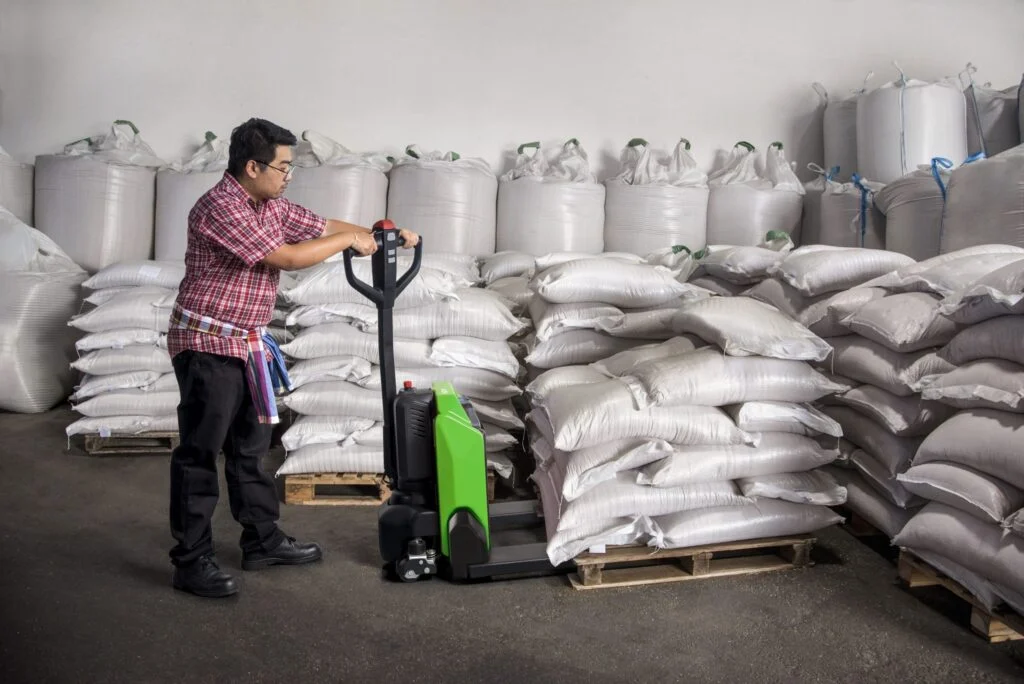
An electric pallet truck is one of the simplest ways to speed up loading, unloading and order picking. It takes the physical strain out of moving heavy pallets and lets one person do work that would otherwise wear out two.
But there is a wide spread of machines, from basic hand units to rider trucks and stackers. This guide explains the differences, what to check before you buy and how to keep your team safe.
Hand pallet truck vs electric pallet truck
A hand pallet truck uses a pump handle to raise the forks hydraulically, and the operator pushes and pulls the load. It is cheap, needs no charging and is ideal for occasional moves over short, flat distances.
Once loads get heavier, distances longer or moves more frequent, manual handling becomes the limiting factor. Pushing a heavy pallet up a slight slope or across a rough floor puts real strain on backs and shoulders. A powered pallet truck does the lifting and the travel, so the operator simply steers.
- Hand units suit small shops, deliveries and low daily volumes.
- Electric walkie trucks suit regular moves across a warehouse, yard or loading bay.
- Rider trucks suit long distances and high throughput in distribution centres.
- Stackers suit sites that need to lift pallets onto racking, not just move them at floor level.
Walkie or rider: which powered pallet truck?
Pedestrian (walkie) trucks are steered with a tiller arm while the operator walks alongside or behind. They are compact, manoeuvrable in tight aisles and quick to learn.
Rider trucks add a platform or seat, so the operator travels with the load. They make sense when each move covers a long distance, for example from one end of a large unit to the other, because walking speed no longer limits productivity.
Where an electric pallet truck fits best
Typical users include warehouses, builders’ merchants, farm stores, food producers and workshops receiving palletised deliveries. If your team loads lorries from a dock or moves feed, fertiliser or parts around a store, a walkie truck is often the right starting point.
Running costs of an electric pallet truck
Purchase price is only one part of the cost. An electric pallet truck also needs charging, periodic servicing and, eventually, a replacement battery, so budget for these from day one.
Against that, look at the time saved per move and the reduced risk of manual handling injuries. For many sites, a single electric pallet truck replaces several hand units and pays its way within a few busy seasons. If budgets are tight, hiring first lets you test the idea before you buy.
Capacity, forks and floor conditions
Capacity is the first figure most people look at, but it is only part of the picture. Check the manufacturer’s rating against your heaviest pallet, with some headroom for awkward or uneven loads.
Fork length and width need to suit the pallets you handle, whether UK standard, Euro or something bespoke. Wheel material matters too: some compounds work best on smooth concrete, while others cope better with joints, ramps and the odd outside run. Most pallet trucks are designed for firm, level floors, so ask before using one on gravel or broken surfaces.
Lithium batteries and charging
Battery choice has a big effect on running costs and how the truck fits into your day. Lithium-ion batteries are now common on smaller trucks because they charge quickly, need no topping up and can be opportunity charged during breaks.
Traditional lead-acid batteries still have a place, especially on larger fleets with planned charging routines. Whatever you choose, plan where trucks will charge and make sure the area is well ventilated and kept clear. Hoppecke industrial batteries and charging systems cover forklifts and material handling fleets, from individual batteries to turnkey charging stations.
Battery care tips
- Follow the manufacturer’s charging guidance rather than leaving trucks part-charged for long periods.
- Keep terminals and connectors clean and check cables for damage.
- Store and charge trucks out of walkways and away from flammable materials.
Choosing an electric pallet truck: step by step
A short checklist helps you avoid buying too much machine, or too little.
- Weigh your heaviest regular pallet and note how often you move it.
- Measure the longest typical travel distance and any ramps or slopes.
- Check aisle widths, door openings and lift or dock plate dimensions.
- Decide whether you need to lift onto racking, which points to a stacker.
- Choose a battery type that fits your shift pattern and charging space.
- Confirm who will service the truck and how quickly you can get parts.
Conagri supplies Noblelift pallet trucks, stackers and lithium forklifts. Noblelift is the world’s largest manufacturer of hand pallet trucks and also builds powered pallet trucks, reach trucks and warehouse automation. You can see the full range of material handling equipment, including lithium-ion forklifts, stackers and industrial cleaning machines, available for sale and hire from our Devon base.
Training and safe use
An electric pallet truck is easy to drive, which is exactly why short cuts creep in. Anyone using one should be trained and assessed, and you should keep a record. The HSE’s L117 code of practice on rider-operated lift trucks sets out training principles that are a sensible benchmark for pallet trucks too.
- Carry out a pre-use check of forks, wheels, brakes, horn and the emergency stop.
- Never exceed the rated capacity or carry passengers.
- Keep the load low, travel slowly on ramps and follow the manufacturer’s guidance on load direction.
- Separate pedestrians from trucks where you can, and use mirrors at blind corners.
Parts, servicing and keeping trucks running
Pallet trucks work hard and the wear items are predictable: wheels, rollers, seals, switches and batteries. Regular servicing keeps lifting smooth and spots worn wheels before they damage floors.
Conagri can source material handling parts such as forks, tyres, batteries and mast components for the machines we supply and many other brands. For urgent orders you can send a part number by WhatsApp on +44 784 103 6064.
Finding the right electric pallet truck
The right electric pallet truck saves time, protects your team and pays for itself in fewer strains and faster loading. Start with load weights, distances and floor conditions, then match the battery to your working day.
Our team in Crediton can help you compare hand, walkie, rider and stacker options and arrange a demonstration. Call +44 (0)1392 984258 or get in touch online for advice and a quote.
Frequently asked questions
Is an electric pallet truck worth it over a hand pallet truck?
If you move heavy pallets regularly, over longer distances or up slopes, yes. An electric pallet truck does the lifting and travelling, which cuts operator fatigue and the risk of strain injuries. For light, occasional moves over short flat distances, a hand pallet truck is often enough.
Do you need training to use a powered pallet truck?
Yes. Employers must make sure anyone using work equipment is trained and competent. Operators should learn pre-use checks, load limits, safe travel and charging procedures, and be assessed before working unsupervised. Keeping training records helps you show the truck is being used safely.
How long does a lithium pallet truck battery last on a charge?
It depends on the battery capacity, load weight, distance travelled and how often the truck is used. Lithium batteries can be topped up during breaks without harming them, which helps many sites run a full shift. Check the manufacturer’s figures for your model and duty cycle.
What is the difference between a pallet truck and a stacker?
A pallet truck lifts the load just clear of the floor so it can be moved. A stacker has a mast and can raise pallets to racking or onto benches. If you need to store goods at height, choose a stacker or a forklift rather than a pallet truck.