
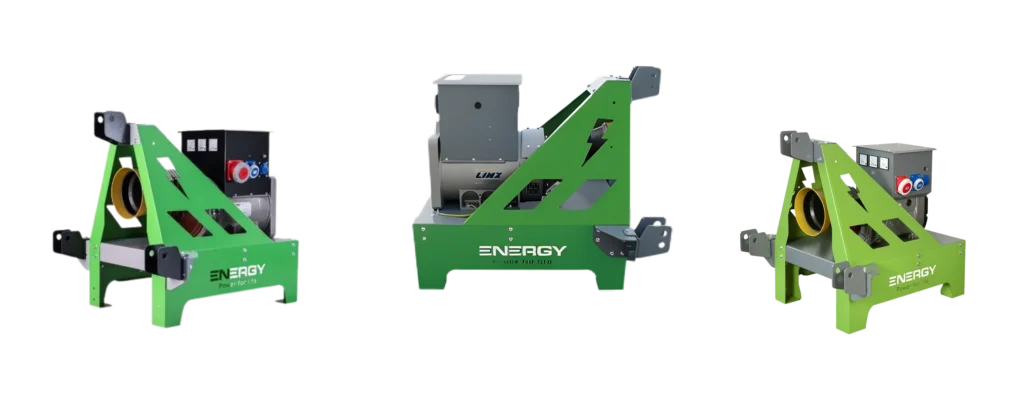
A PTO generator is one of the most practical ways to protect a farm from winter power cuts. Storms, snow and ice can bring down overhead lines for hours or even days, and livestock still need milking, feeding, water and ventilation whatever the weather.
By using a tractor you already own as the engine, a power take-off generator gives you reliable backup without the cost of a separate engine. This guide explains how it works, how to size it, what it can run and when a standalone diesel generator is the better choice.
How a PTO generator works
A PTO generator has no engine of its own. It connects to the tractor’s power take-off with a driveshaft, and the tractor turns the alternator to produce electricity. That means any farm with a suitable tractor can make power wherever it is needed, from the yard to an outlying building.
The Energy Agripower range works on exactly this principle. Energy agricultural generators are built in Italy by Energy Gruppi Elettrogeni, an ISO 9001:2015 certified company founded in 2003, and the range runs from 10 to over 160 kVA.
PTO generators are usually mounted on the three-point linkage or on a small trailer, so they can be moved between buildings as needed. Between outages, the same unit can power tools and lighting at remote sites, fencing jobs or events, which helps the investment pay its way through the year.
Why PTO speed matters
The generator is designed to run at a set PTO speed, usually 540 or 1,000 rpm depending on the model. Keeping the tractor at that speed holds the voltage and frequency steady, which protects motors, controllers and electronics. Most farms set the throttle once the load is running and keep an eye on the generator’s meter.
Sizing a PTO generator to your tractor
Start by working out what you need to run, then make sure the tractor can drive it. An oversized generator on a small tractor will bog down when motors start, while an undersized one will trip or overheat.
Follow these steps to size your system:
- List every essential load you want to keep running during a power cut.
- Note the running power of each item, from the rating plate or manual.
- Allow extra for starting loads, as electric motors draw much more power for a moment as they start.
- Add the totals to find the generator output you need, plus a margin for safety.
- Check the manufacturer’s rating for the PTO horsepower the generator needs at full load.
- Compare that with your tractor’s PTO power, leaving spare capacity for steady running.
Your tractor needs enough power to do the job comfortably for hours at a time. McCormick tractors run from 49 to 310 HP, are Stage V compliant and have 1,000-hour service intervals, which suits long periods of generator work.
Single-phase or three-phase?
Check what supply your farm uses before you buy. Many parlours, grain dryers and larger motors run on three-phase power, while houses and smaller buildings are usually single-phase. A PTO generator must match the supply it replaces, so ask your electrician to confirm the phase, voltage and largest motor on the system. Some generators can provide both, which adds flexibility for mixed sites.
What a tractor generator can run on the farm
A well-sized tractor generator can keep the core of the farm working through a long outage. Typical essential loads include:
- Milking parlour vacuum pumps and controls
- Bulk milk tank cooling
- Water heating for parlour washing
- Water pumps for livestock drinkers
- Ventilation and fans in livestock housing
- Lighting in sheds, yards and calving pens
- Grain dryers and cold stores
You may not need everything at once. Many farms run the parlour first, then switch to cooling, water and lighting once milking is over. Staggering loads in this way lets a smaller PTO generator cover more of the farm.
In a hard frost, think about heating too. Trace heating on pipework, heat lamps for young stock and frost protection in the parlour can all be critical, but heaters draw a lot of power, so include them in your sizing from the start.
Connecting a PTO generator safely
Safe connection is essential. A generator must never feed power back into the mains network, because that could injure line workers repairing the fault. Have a qualified electrician fit a proper changeover switch, so buildings are isolated from the grid before the generator supplies them.
Earth the generator correctly, protect cables from vehicles and stock, and keep the PTO shaft guard in good condition. The HSE’s electrical safety guidance covers safe systems for portable and temporary supplies.
Test your setup before winter. Run the tractor and generator under load for a short period every few months, so you know everything works and staff are confident with the changeover routine.
Fuel and running time
During a long outage, the tractor’s fuel tank becomes your power supply. Keep a reserve of diesel on the farm through the winter, and know roughly how long the tractor can run at generator load on a full tank. Plan who will refuel, check oil and coolant, and watch for warning lights if the generator runs through the night.
PTO generator or standalone diesel standby power?
A PTO generator is cost-effective farm backup power, but it relies on a free tractor and someone to start it. If an outage hits overnight, or the tractor is needed elsewhere, that can be a problem.
A standalone diesel generator offers automatic standby power. It can start within seconds of a mains failure and run without a person present, which suits large dairies, poultry and pig units, and cold stores. Zenessis diesel and gas generators run from 1 kVA to 5,000 kVA, including soundproofed models that start automatically and stationary industrial units built for heavy, continuous use.
Energy also offers an Industrial range that gives continuous prime or standby power for livestock buildings, grain dryers, milking parlours and cold stores. Many farms combine the two approaches, with a fixed standby set for critical loads and a PTO generator for outlying buildings.
Planning your farm backup power
The right PTO generator depends on your essential loads, your tractor and how quickly you need power back when the mains fails. Size it carefully, connect it safely and test it before the first winter storm arrives.
Browse our full agricultural equipment range, or call our Crediton team on +44 (0)1392 984258. You can also send us an enquiry and we will help you plan reliable backup power for your farm.
Frequently asked questions
How does a PTO generator work?
A PTO generator has no engine of its own. It connects to your tractor’s power take-off through a driveshaft, and the tractor’s engine turns the alternator to produce electricity. Running the tractor at the correct PTO speed keeps the voltage and frequency stable, so the generator can power farm equipment wherever the tractor can reach.
What size tractor do I need for a PTO generator?
It depends on the generator’s output and the loads you plan to run. As a broad guide, the tractor should have comfortably more PTO horsepower than the generator needs at full load, and enough spare to cope with motors starting. Check the generator manufacturer’s rating and your tractor’s PTO power before you buy.
Can a PTO generator run a milking parlour?
Yes, if it is sized correctly. Add up the running and starting loads of the vacuum pump, milk cooling, water heating, lighting and controls, then choose a generator with enough capacity. A qualified electrician should connect it through a changeover switch so the parlour can be switched safely to generator power.
Is a PTO generator or a diesel standby generator better for a farm?
A PTO generator is cheaper to buy and uses a tractor you already own, but someone must start and run it. A standalone diesel standby generator can start automatically when the mains fails and run unattended, which suits sites that cannot be without power, such as large dairies, poultry units or cold stores.