A scrubber dryer cleans and dries a hard floor in a single pass, which makes it the workhorse of industrial floor cleaning in warehouses, factories and large commercial buildings. Compared with a mop and bucket, it is faster, more hygienic and leaves the floor safe to walk on almost immediately.
Choosing the right machine still takes some thought. This guide compares walk-behind and ride-on scrubbers, explains when a sweeper is the better tool, and looks at battery choice and day-to-day care so you get a machine that suits your site.
What does a scrubber dryer do?
The machine lays down a measured flow of water and detergent, scrubs the floor with rotating brushes or pads, then a rear squeegee and vacuum motor lift the dirty water into a recovery tank. What you leave behind is a clean, nearly dry surface.
That combination of scrubbing and recovery is what sets a scrubber dryer apart. Mopping spreads dirty water around and leaves floors wet and slippery, while a machine removes the dirt from the building altogether. On large floors it also saves a great deal of labour.
You will find these machines in distribution centres, manufacturing plants, food production, supermarkets, hospitals, schools and transport hubs. Anywhere with a large area of hard floor and a need for regular, consistent cleaning is a candidate.
Scrubber dryer or sweeper?
Sweepers and scrubbers do different jobs, and many sites need both. The right answer depends on what is on your floor.
When a sweeper makes sense
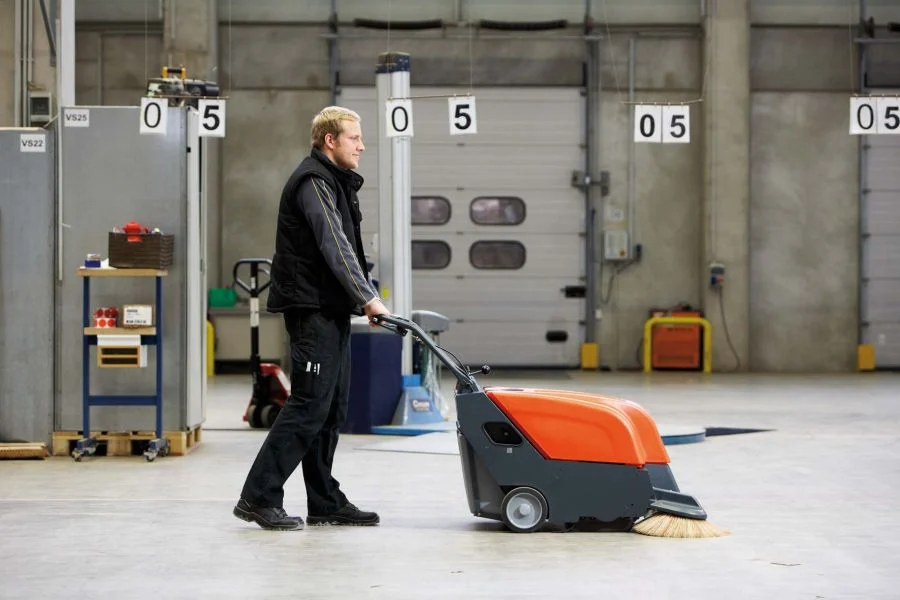
A sweeper collects dry debris: dust, grit, shrink-wrap, cardboard and pallet splinters. Outdoor yards, loading bays and car parks often need nothing more. A ride on sweeper covers big areas quickly and suits busy distribution centres, while smaller walk-behind sweepers work well in workshops and stores.
When you need a floor scrubber
A floor scrubber tackles what sweeping leaves behind: oily residue, spills, tyre marks from forklifts and the fine grime that makes floors slippery. Food production, healthcare, retail and any site with sealed or painted floors usually needs regular scrubbing. Sweeping first protects the scrubber’s brushes and squeegee and keeps the recovery tank cleaner.
Walk-behind vs ride-on scrubber dryer
Walk-behind machines
A walk-behind scrubber dryer suits smaller areas, narrow aisles, shops, workshops and spaces with lots of obstacles. Machines are easier to store, cheaper to buy and simple to learn. Compact models can reach into corners and between racking that a larger machine cannot.
Ride-on machines
Ride-on scrubbers cover large, open floors far faster, with bigger tanks and wider cleaning paths. They reduce operator fatigue on long shifts and are the usual choice for big warehouses and factories cleaned every day. When comparing models, consider:
- Area to clean per shift and how often you clean it.
- Aisle widths, turning space and any ramps or slopes.
- Floor type: sealed concrete, resin, tiles or textured safety flooring.
- Type of dirt: dust, oil, food waste or tyre marks.
- Tank sizes, so the machine is not stopping constantly to empty and refill.
- Brush type: disc brushes for general scrubbing, cylindrical brushes that also pick up small debris.
- Noise level if cleaning happens during working hours or in public areas.
Batteries, charging and running costs
Battery choice
Most industrial cleaning machines run on batteries, and the battery has a big effect on run time and running cost. Traditional lead-acid batteries are proven and affordable but need regular watering and a full charge cycle. Sealed batteries reduce maintenance, and lithium-ion options allow quick opportunity charging during breaks with no watering at all.
Match the battery capacity to your longest cleaning shift with some margin, and plan a safe, ventilated charging area. Hoppecke industrial battery systems cover forklifts, cleaning machines and material handling equipment, along with turnkey charging stations, so one supplier can support your whole fleet.
Counting the full cost
The purchase price is only part of what a scrubber dryer costs you. Labour is usually the largest cost in floor cleaning, so a machine that cleans more square metres per hour can pay for itself even if it costs more to buy. Water, detergent, pads, brushes, squeegee blades and eventual battery replacement all add up over the years too.
Ask how much water and chemical each model uses, whether it has an economy mode, and how easy it is to swap wear parts without tools. Simple features such as colour-coded touch points and easy tank access save minutes every shift and make it more likely that operators look after the machine properly.
Hako and Eureka machines from Conagri
Hako, founded in Germany in 1948, makes compact scrubber-driers, multifunctional municipal sweepers and indoor and outdoor cleaning solutions. It was the first manufacturer worldwide to receive the AGR quality label for back-friendly scrubber-driers. Conagri supplies Hako cleaning machines in Southwest England with full sales, service and parts support.
Eureka builds walk-behind scrubber dryers, ride-on sweepers and escalator cleaners in Italy for warehouses, retail, healthcare and commercial sites. Its patented ECOsystem technology saves up to 80 percent on water, detergent and labour costs. You can buy Eureka floor cleaning machines through Conagri, and Eureka cleaning equipment is also available from our hire centre if you want to try before you commit.
Running a scrubber dryer safely and efficiently
Good daily habits keep cleaning results consistent and extend machine life. Build a short routine into every shift:
- Sweep or remove loose debris and obstacles before scrubbing.
- Fill the solution tank with clean water and the correct detergent dose.
- Check brushes or pads for wear and fit the right type for the floor.
- Clean and inspect the squeegee blades, as worn blades leave streaks and wet patches.
- After cleaning, empty and rinse the recovery tank and leave the lid open to dry.
- Put the battery on charge and follow the manufacturer’s watering schedule if required.
Ride-on machines share space with pedestrians and forklifts, so treat them as workplace vehicles. Train operators, plan cleaning routes and times, and use warning signs where floors may still be damp. The HSE workplace transport guidance is a useful reference for managing vehicles and people together.
Getting the right scrubber dryer for your site
Start with floor area, layout and the kind of dirt you deal with, then choose between walk-behind and ride-on, decide whether a sweeper should do the first pass, and match the battery to your shifts. The right scrubber dryer will give you cleaner, safer floors with less labour.
Conagri supplies Hako, Eureka and Hoppecke alongside forklifts and other material handling equipment, with service from our base in Devon. To discuss a demonstration or quote, contact our team or call +44 (0)1392 984258.
Frequently asked questions
What is a scrubber dryer used for?
A scrubber dryer cleans hard floors in one pass. It lays down water and detergent, scrubs the surface with rotating brushes or pads, then a squeegee and vacuum pick up the dirty water. The floor is left clean and almost dry, so people can walk on it straight away. It suits warehouses, factories, retail and healthcare sites.
Should I choose a walk-behind or ride-on scrubber dryer?
Choose by floor area, layout and how often you clean. Walk-behind machines suit smaller areas, congested aisles, shops and workshops, and are easier to store and move. Ride-on machines cover large open floors much faster with less operator fatigue, which makes them the usual choice for big warehouses and distribution centres cleaned every shift.
Do I need a sweeper as well as a floor scrubber?
Many sites benefit from both. A sweeper collects dry debris such as dust, grit, packaging and pallet fragments, while a floor scrubber removes grime, oil and tyre marks that sweeping leaves behind. Sweeping first protects the scrubber’s brushes and squeegee and keeps the recovery tank cleaner. Outdoor yards often need only a sweeper.
Which cleaning machine brands does Conagri supply?
Conagri offers Hako and Eureka industrial floor cleaning machines with sales, service and parts support. Hako makes compact scrubber-driers and sweepers, and Eureka makes walk-behind scrubber dryers, ride-on sweepers and escalator cleaners. Hoppecke industrial batteries and charging stations are also available for cleaning machines and forklifts.