
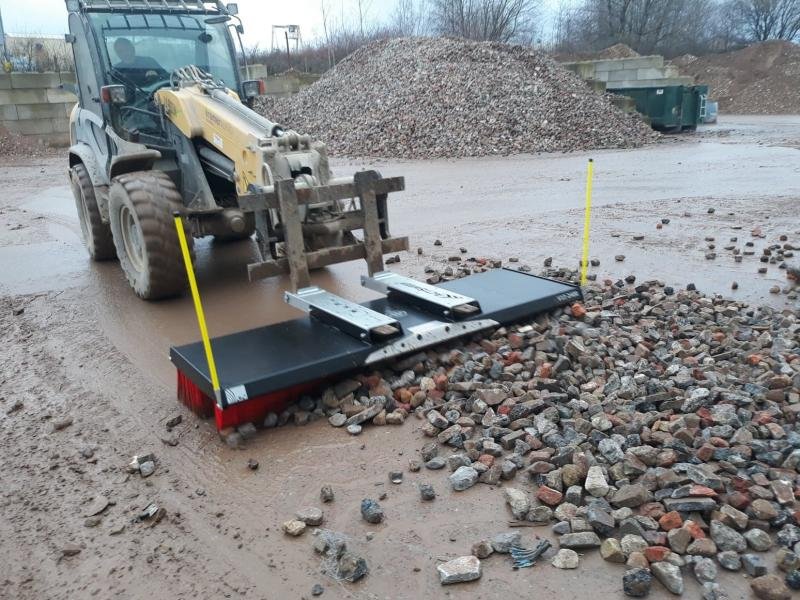
A tractor sweeper is one of the quickest ways to keep a farm yard, shed or site safe and tidy. Mud, slurry, straw and spilt feed build up fast around buildings and gateways, and clearing them by hand takes time you rarely have.
There are three main types to choose from: push brooms, rotary brush sweepers and collector sweepers. This guide explains how each works, which carriers they suit and what to look for, so you can pick the right sweeper for your ground.
Why a clean yard matters
A clean yard is safer to work in and easier to manage. Mud and slurry make surfaces slippery for people, stock and vehicles, and loose material washes into drains when it rains.
Regular sweeping with a tractor sweeper also helps with biosecurity, keeps feed and bedding areas cleaner and makes the farm look well run to visitors, buyers and inspectors. On construction sites, it keeps access roads clear and stops mud being carried onto public roads.
Yards and sites are busy places, so plan sweeping around vehicle movements. The HSE’s workplace transport guidance covers keeping people and vehicles apart and good visibility when machines are working.
Push broom sweepers
A push broom sweeper is the simplest tractor sweeper. The carrier pushes a fixed brush across the surface, and the bristles move material forward into a heap at the end of the run.
Push brooms need no hydraulics or drive, so they are cheap to run and quick to fit. They work well on daily yard cleaning, scraping passages and clearing loose straw, mud and slurry from concrete.
Their limits show on heavier jobs. A push broom moves material rather than lifting it, so dried, caked mud may need a scrape first, and you will still need somewhere to leave the heap at the end of each run. For daily cleaning of a working yard, though, few machines are quicker to hitch up and use.
The Actisweep V-Concept
A conventional straight push broom tends to leave windrows along each side. The Actisweep yard sweeper uses a patented V-shaped brush that sweeps larger quantities in a single pass without leaving those side windrows, and is quoted as up to 30% more efficient.
Actisweep sweepers need no hydraulics and no maintenance: you attach, sweep, then rinse and store. They attach in about five seconds and fit tractors, forklifts, loaders and telehandlers. The range covers the entry-level V7, with widths from 1.5m to 2.5m, the popular V9 and the heavy-duty V13.
Rotary brush sweepers
A rotary brush tractor sweeper uses a hydraulically or PTO-driven cylindrical brush that spins as you drive. The rotation lifts and throws material, which helps with caked-on mud, heavier deposits and larger areas.
Rotary brushes can usually be angled to push material to one side, which makes them popular for clearing tracks and yards in long runs. They need hydraulic or PTO power, and the drive and bearings need regular checks, so running costs are higher than a push broom.
Collector sweepers and tractor road sweepers
Collector sweepers add a hopper behind or around the brush, so material is picked up rather than pushed into a pile. Tractor road sweepers of this type are common on construction sites, at quarries and on roads where mud must be removed rather than moved aside.
For larger estates, commercial premises and public areas, a dedicated machine may make more sense than a tractor attachment. Hako makes multifunctional municipal sweepers and outdoor cleaning solutions, as well as load and implement carriers.
How to choose a tractor sweeper
Work through these steps to find the right sweeper:
- Identify the main surface, such as concrete, tarmac or compacted hardcore.
- Decide what you are sweeping, from loose straw to caked mud or slurry.
- Choose whether material can be pushed into heaps or must be collected.
- Check which carriers you have and how the sweeper will mount.
- Measure the widths you need to cover, including passages and gateways.
- Compare running costs, including brush life, hydraulics and maintenance.
When comparing models, look at these features:
- Brush width compared with your carrier’s track width
- Bristle density and material
- Mounting options for tractors, loaders, telehandlers and forklifts
- How easily brushes can be replaced
- Weight and suitability for the carrier’s front or rear linkage
Matching a tractor sweeper to your carrier
Most farms already own the machine that will carry the sweeper, so start there. A tractor sweeper on the front linkage or loader gives good visibility of the brush, while a rear-mounted unit suits long runs on tracks and roads. Telehandlers and loaders are handy for yards because they can lift the brush clear and reach awkward corners.
Make sure the brush is at least as wide as the carrier’s tyres, so you are not driving through the material you have just swept. On a narrow farm with tight passages, a smaller width is often quicker overall.
Getting the best from your sweeper
Sweep little and often. Material is much easier to move when it is fresh than when it has dried hard or been driven into the surface. Keep down pressure light, because pressing the brush too hard wears the bristles quickly without cleaning any better.
Rinse the brush after use, particularly after slurry, and store it off the ground or on its stand so the bristles keep their shape. Dense polypropylene bristles on the Actisweep V9 and V13 last over 1,000km, so a well-kept brush gives years of use.
Seasonal jobs for a tractor sweeper
A tractor sweeper earns its keep all year. In winter, it clears mud from gateways, feed passages and the yard around housed stock. In spring and autumn, it keeps lanes clean after muck spreading, drilling and harvest traffic, which matters where machines join public roads.
In summer, it tidies grain stores and sheds before harvest, and clears dust and debris around buildings. Light snow can also be pushed aside with a brush on hard standing.
On construction sites, the same principles apply. The Actisweep range for construction and public works is built heavy duty with easy brush replacement, for clearing roads, yards and work areas.
Choosing the right tractor sweeper for your yard
The right tractor sweeper depends on what you sweep, how often and which machines you already own. For most farm yards, a push broom with a V-shaped brush offers the best mix of low cost and fast cleaning, while rotary and collector sweepers suit heavier and roadside work.
Explore our full agricultural equipment range, call our Crediton team on +44 (0)1392 984258, or send us an enquiry and we will help you choose a sweeper to suit your carrier.
Frequently asked questions
What is the best tractor sweeper for a farm yard?
For most farm yards, a push broom or V-shaped sweeper is the simplest choice, because it needs no hydraulics and very little maintenance. Rotary brush sweepers suit heavier, caked-on mud and wider areas, while collector sweepers are best where material must be picked up and removed, such as on roads and public areas.
Does a push broom sweeper need hydraulics?
No. A push broom sweeper is pushed by the carrier machine and the brush does the work without any powered drive. Actisweep sweepers, for example, have no hydraulic connections and no maintenance, so you simply attach, sweep, then rinse and store. That keeps running costs low and avoids hose and motor repairs.
Can I fit a yard sweeper to a telehandler or forklift?
Yes. Many yard sweepers are designed to fit a range of carriers, including tractors, loaders, telehandlers and forklifts, using the machine’s existing brackets or tines. Check the mounting type and the width of the sweeper against your carrier before ordering, so the brush sits square and covers the tyre tracks.
How long do sweeper brushes last?
Brush life depends on the bristle material, the surface and how hard the brush is pressed down. Dense polypropylene bristles last well on concrete, and Actisweep quotes over 1,000km of use for its V9 and V13 brushes and around 800km for the V7. Keeping down pressure light helps brushes last longer.