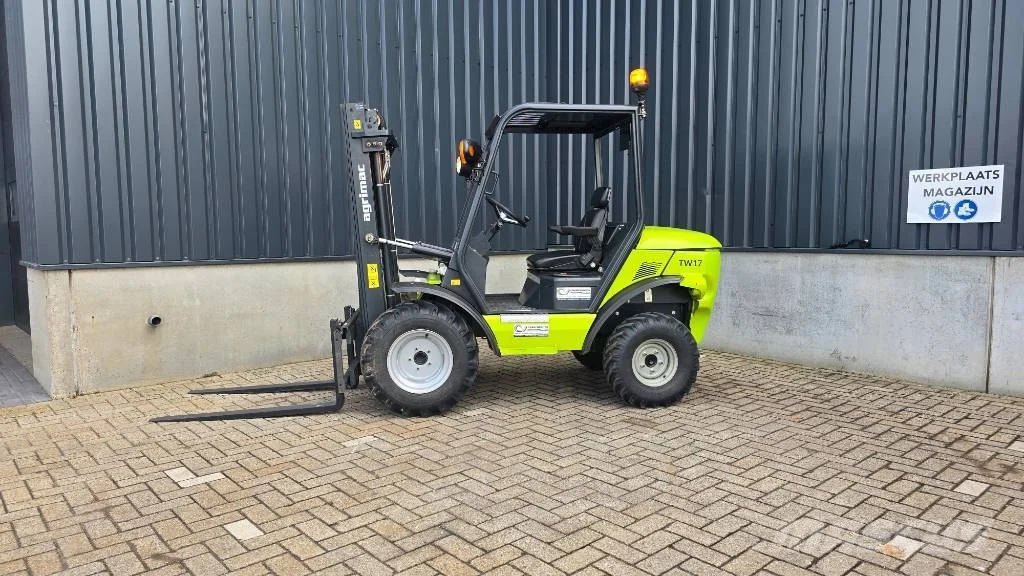
A rough terrain forklift lets you lift and move pallets, bags and materials across ground that would stop a warehouse truck in its tracks. Farms, builders’ yards, vineyards, nurseries and construction sites all rely on them to keep materials moving on gravel, mud and grass.
They are not the only option, though. A telehandler or a loader with forks can sometimes do the same job. This guide explains how they differ, what to look for, and how to match the machine to your site.
What is a rough terrain forklift?
A rough terrain forklift is a counterbalance lift truck designed for outdoor work on uneven ground. Compared with a warehouse truck, it has larger pneumatic tyres with deeper tread, more ground clearance, a stronger chassis and often four-wheel drive.
You may also see it called an all terrain forklift or a 4×4 forklift. The names vary, but the purpose is the same: lifting loads safely where the surface is soft, rough or sloping.
Where they work best
- Farms moving feed, seed, fertiliser and produce on pallets or in bulk bags
- Vineyards and orchards working between rows and on grass
- Builders’ merchants and yards with gravel or broken surfaces
- Construction sites unloading deliveries and moving blocks and pallets
- Timber yards, nurseries and garden centres with mixed surfaces
Telehandler vs forklift: which do you need?
The telehandler vs forklift question comes up on almost every farm and site. Both lift pallets, but they are built for different jobs.
A telehandler has a telescopic boom that gives forward reach and height. It is ideal for stacking bales, loading high trailers and using a wide range of attachments. A rough terrain forklift uses a vertical mast, so it lifts straight up close to the machine. It is usually more compact, quicker in repetitive short cycles, and easier to see around when placing pallets.
A warehouse forklift, by contrast, is built for smooth concrete floors. Its small, hard tyres and low clearance make it unstable and easily stuck outdoors. If your yard is not paved, it is the wrong tool.
Rough terrain forklift features to compare
Drive and tyres
Two-wheel drive suits firm, dry yards. Four-wheel drive gives the traction you need on mud, wet grass and slopes, and is worth having on most farms and building sites. Tyre choice matters too: deep agricultural treads grip in soft ground, while industrial treads last longer on hard, broken surfaces.
Mast and visibility
A duplex or triplex mast changes both lift height and the overall height of the machine. Check that the lowered mast clears your doorways and that you can see the fork tips clearly when placing a load.
Engine and running costs
Diesel remains common for outdoor work, but after-treatment systems add servicing cost. Ask how the machine meets emissions rules and what that means for maintenance over five years or more.
Agrimac all-terrain forklifts
Agrimac all-terrain forklifts for material handling are built in Amorebieta, Spain, where Agrimac has manufactured since 1958. The compact TW12, TW16 and TW17 cover 1.2 to 1.7 tonnes, and the TW20, TW25 and TW35 handle heavier loads up to 3.5 tonnes.
Two features stand out. In-wheel motor technology gives strong performance on rough terrain with minimal maintenance, and the machines need no DPF, which keeps running costs down. Agrimac quotes up to 35 percent lower total cost of ownership.
On the farm, Agrimac forklifts and dumpers for farms and vineyards handle pallets, bags and produce on uneven ground, and the DW35 hydrostatic dumper moves material where a tractor and trailer cannot go.
Fork lift loaders and attachments for heavier work
If your loads are heavier than a typical rough terrain forklift can manage, a fork lift loader may suit you better. SDLG fork lift loaders are wheel loaders adapted for fork work on rough yards, gravel and uneven ground. The L933FL handles pallets, bags and yard materials with a 3,000 kg rated load and an optional 1.8 m³ bucket, while the LFT18H lifts 18,000 kg for pipes, precast concrete and heavy components.
The forks and attachments matter as much as the machine. Invicta forklift forks and attachments, made in Leeds since 1920, range from standard replacement forks to bespoke handling solutions. Worn or damaged forks reduce safe capacity, so inspect them regularly.
7 smart tips for choosing a rough terrain forklift
Work through these points before you request quotes.
- Weigh your heaviest regular load. Include the pallet and any attachment, then check it against the load chart at the height you need.
- Check the load centre. Bulky loads such as bulk bags sit further out on the forks and reduce real capacity.
- Measure your lift height. Choose a mast that reaches your highest stack or trailer bed with a sensible margin.
- Look at the ground. Soft or steep ground calls for four-wheel drive, good clearance and the right tyres.
- Measure the tightest spaces. Doorways, vineyard rows and container doors set limits on width and height.
- Compare running costs. Fuel, servicing, tyres and after-treatment systems all add up over the machine’s life.
- Plan for support. Ask about service response, parts availability and operator training.
Operating a rough terrain forklift safely
Lift trucks are involved in many serious workplace accidents, often through overturns, falling loads or people being struck. On rough ground, the risk of tipping is higher, so travel with the load low and tilted back, drive slowly on slopes, and never turn across a gradient with a raised load.
Anyone operating a lift truck at work must be trained and assessed as competent. The HSE’s approved code of practice on rider-operated lift trucks (L117) sets out training and safe use. The forklift and its forks must also have regular thorough examinations under LOLER, and daily pre-use checks of tyres, brakes, hydraulics, mast chains and forks should become routine.
Getting the right rough terrain forklift for your site
The right rough terrain forklift is the one that lifts your real loads, at the heights you need, on the ground you actually work on. For many farms and yards that means a compact all terrain forklift; for heavier site work, a fork lift loader may be the better fit.
Conagri supplies Agrimac, SDLG and Invicta with sales, service and parts support. Tell us what you lift and where, and we will help you compare options. Contact the Conagri team, call +44 (0)1392 984258, or visit us at Burston Lane, Crediton.
Frequently asked questions
What is a rough terrain forklift?
A rough terrain forklift is a counterbalance lift truck built for uneven, unpaved ground. It has larger tyres with deeper tread, more ground clearance and often four-wheel drive, so it can move pallets and bulk bags across yards, fields and building sites where a warehouse forklift would get stuck or become unstable.
Should I choose a telehandler or a rough terrain forklift?
Choose a telehandler if you need forward reach, high stacking or a range of attachments such as buckets and grabs. Choose a rough terrain forklift if most of your work is lifting and moving pallets at modest heights, because it is usually more compact, quicker in short cycles and simpler to operate and maintain.
How much can an all terrain forklift lift?
It depends on the model, and the rated capacity reduces as the load centre moves further out or the mast goes higher. Agrimac all-terrain forklifts, for example, cover 1.2 to 1.7 tonnes in the compact TW12, TW16 and TW17, and up to 3.5 tonnes in the TW35. Always work within the machine’s load chart.
Do rough terrain forklift operators need training?
Yes. Anyone operating a rider-operated lift truck at work must be trained and assessed as competent, and employers must provide that training and keep records. The HSE’s approved code of practice L117 sets out what good training looks like. Lifting equipment must also have regular thorough examinations under LOLER.