
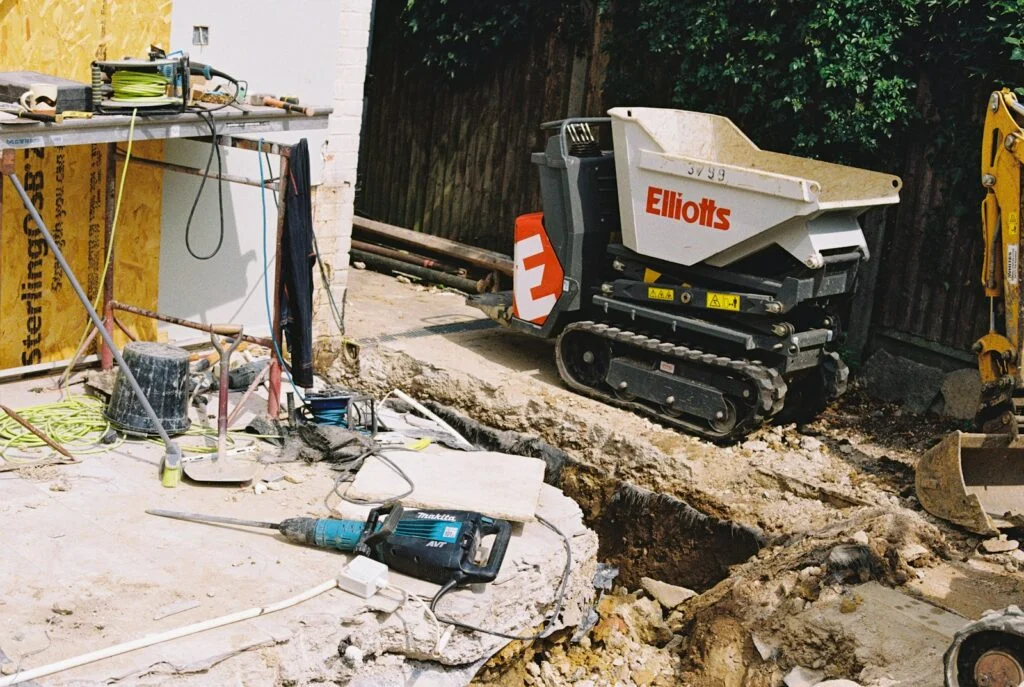
A tracked dumper moves soil, rubble and aggregate across ground where a wheeled machine would sink or spin. On tight access jobs, soft ground and slopes, it can save hours of barrow work and protect the surface you are crossing.
This guide compares tracked and wheeled dumpers, explains capacity and skip types, and looks at electric options. It also covers safe working on slopes and soft ground, and when to buy or hire.
Tracked vs wheeled dumpers
Tracks spread the machine’s weight over a much larger area, so ground pressure is lower. That means better grip on mud, turf and slopes, and less rutting on finished landscaping.
- Tracked: low ground pressure, strong grip on soft and sloping ground, compact widths for narrow access, slower travel.
- Wheeled: faster over firm ground and longer hauls, simpler undercarriage, but more likely to bog down or mark turf.
- Pedestrian or ride-on: small walk-behind units suit gardens and doorways, while ride-on machines carry more over longer distances.
Tracks do have trade-offs. Rubber tracks wear faster on concrete and tarmac, and turning on the spot can scuff turf, so plan wide, gentle turns on finished surfaces.
If most of your work is on firm haul roads, a wheeled machine may serve you better. The Agrimac DW35 hydrostatic site dumper uses in-wheel motors for a compact yet powerful design over rough ground, and needs no DPF.
Choosing tracked dumper capacity
Start with access. Measure the narrowest gate, doorway or path on a typical job, then choose the largest payload that fits through it.
Next, match the dumper to the digger loading it. A good pairing fills the skip in a few bucket loads, so neither machine stands idle waiting for the other.
Remember that a rated payload assumes firm, level ground. On slopes or soft ground, run lighter loads, and check whether a figure is a weight or a heaped volume, because wet clay is far heavier than topsoil.
For larger sites, HyperMec wheeled and tracked dumpers, built in northern Italy, carry payloads of up to 6,000kg with transfer speeds of up to 30km/h and Bosch-Rexroth transmissions.
Skip types: standard, high-tip and swivel
Standard tipping skip
The skip tips forward at ground level. It is the simplest and lightest option, ideal for dumping spoil in a heap or into a trench.
High-tip skip
A high-tip skip lifts before tipping, so you can load directly into a skip, trailer or lorry. It saves double handling but adds weight and cost, and the machine must be on firm, level ground when raised.
Swivel or rotating skip
A swivel skip turns to tip to either side, which helps along trenches, in narrow gardens and beside walls. Some machines also offer a self-loading shovel, so one operator can load without a digger.
Electric dumper options
An electric dumper produces no exhaust at the point of use and runs much more quietly. That makes it the natural choice for indoor demolition, basements, homes, schools and hospitals, and for sites with tight noise limits.
Battery life was once the worry, but it has moved on. HG electric dumpers, hand-built in Denmark by a family company making dumpers since 1971, run for up to 12 hours on a single charge, matching or beating combustion models.
Plan charging around the working day. Most operators charge overnight, so check site power and keep a charging point protected from weather and traffic.
Tracked dumper maintenance and running costs
Tracks and undercarriage are where a tracked dumper costs money if neglected. A few minutes of care each day protects the machine and keeps it earning.
Tracks and undercarriage
Check track tension daily. A loose track can come off on a slope or in a turn, while one that is too tight wears sprockets, idlers and rollers quickly. Clean out packed mud and stones at the end of each day, especially before a frost.
Avoid long runs on tarmac and sharp pivot turns on abrasive surfaces where you can. Cuts, exposed steel cords and missing lugs mean a replacement track is due soon.
Engine, hydraulics and batteries
On diesel machines, follow the service intervals for oil, filters and coolant, and keep the radiator screen clear on dusty sites. Check hydraulic hoses for chafing around the skip pivot and rams.
An electric dumper has no engine oil or fuel filters to change, which cuts routine servicing. Charge the battery as the manufacturer recommends, and store the machine somewhere frost-free where possible.
Using a tracked dumper safely on slopes and soft ground
Dumper overturns remain a well-known cause of serious site injuries. Training, planning and a few habits make a big difference, so run through these points on every job:
- Walk the route first and mark soft ground, edges, excavations and overhead hazards.
- Travel straight up and down slopes, never across them, and keep the skip on the uphill side when loaded.
- Do not overload, and keep loads low and even so you can see ahead.
- Use stop blocks at trench and tipping edges to prevent the machine running over.
- Lower a high-tip skip fully before moving, and only raise it on firm, level ground.
- Wear the seat belt where a roll-over protective structure is fitted.
- Check tracks, brakes and hydraulic hoses at the start of each day.
Only trained, competent operators should drive site dumpers. HSE’s construction safety topics include guidance on dumpers and site transport.
Tracked dumper for sale or hire?
If you have steady work for a machine, buying soon becomes cheaper than hiring. When you compare any tracked dumper for sale, look beyond payload at width, skip type, ground pressure and dealer support for parts and servicing.
On a used machine, check track tension and wear, sprockets and rollers, hydraulic leaks at the rams and drive motors, and play in the skip pivots. Drive it loaded and test every function.
Tracked dumper hire suits one-off projects or a peak in work. Our Crediton hire centre supplies mini excavators, loaders and other site equipment from one day to long-term contractor rates, with delivery across Devon and the Southwest, and the team can advise on dumper options.
Choosing the right tracked dumper for your site
The right tracked dumper fits your access, matches your digger and suits the ground you work on. Decide on skip type and power source early, and a good machine will keep materials moving for years.
To compare diesel and electric models or talk through a purchase, call Conagri on +44 (0)1392 984258, visit us at Burston Lane in Crediton, or send us an enquiry.
Frequently asked questions
What is a tracked dumper used for?
A tracked dumper carries soil, rubble, aggregate and other materials across sites where a wheeled machine would sink or struggle. Rubber tracks spread the weight, so it works on soft ground, turf, slopes and narrow access routes. Builders, landscapers, groundworkers and utility contractors use them alongside mini diggers.
Is a tracked or wheeled dumper better?
Tracked dumpers have lower ground pressure and better grip on soft, wet or sloping ground, and many fit through narrow gaps. Wheeled dumpers travel faster over firm ground and longer distances, and usually cost less to run. Choose based on the ground conditions and haul distances on most of your jobs.
How long does an electric dumper run on a charge?
It depends on the model, load and work pattern. HG electric dumpers run for up to 12 hours on a single charge, which matches or beats traditional combustion models. Electric machines also produce zero emissions and less noise, which suits indoor work, homes, schools and noise-sensitive sites.
What should I check before buying a used tracked dumper?
Check track tension and wear, sprockets and rollers, hydraulic leaks at the skip rams and drive motors, and play in the skip pivots. Start the engine from cold, drive it loaded and test the tip and any swivel function. Ask for service records and make sure the controls return to neutral when released.